"""
Tests an action via Orchestrator REST API

@author Stefan Schnell <mail@stefan-schnell.de>
@license MIT
@version 0.1.0

@param {string} in_actionModule - Name of the module
@param {string} in_actionName - Name of the action
@param {string} in_outputType - Data type of output, default Properties
@param {string} in_script - Script code
@param {string} in_version - Version of the action, default 0.1.0
@param {string} in_runtime - Name of the runtime, if null JavaScript
@returns {Properties}

@example
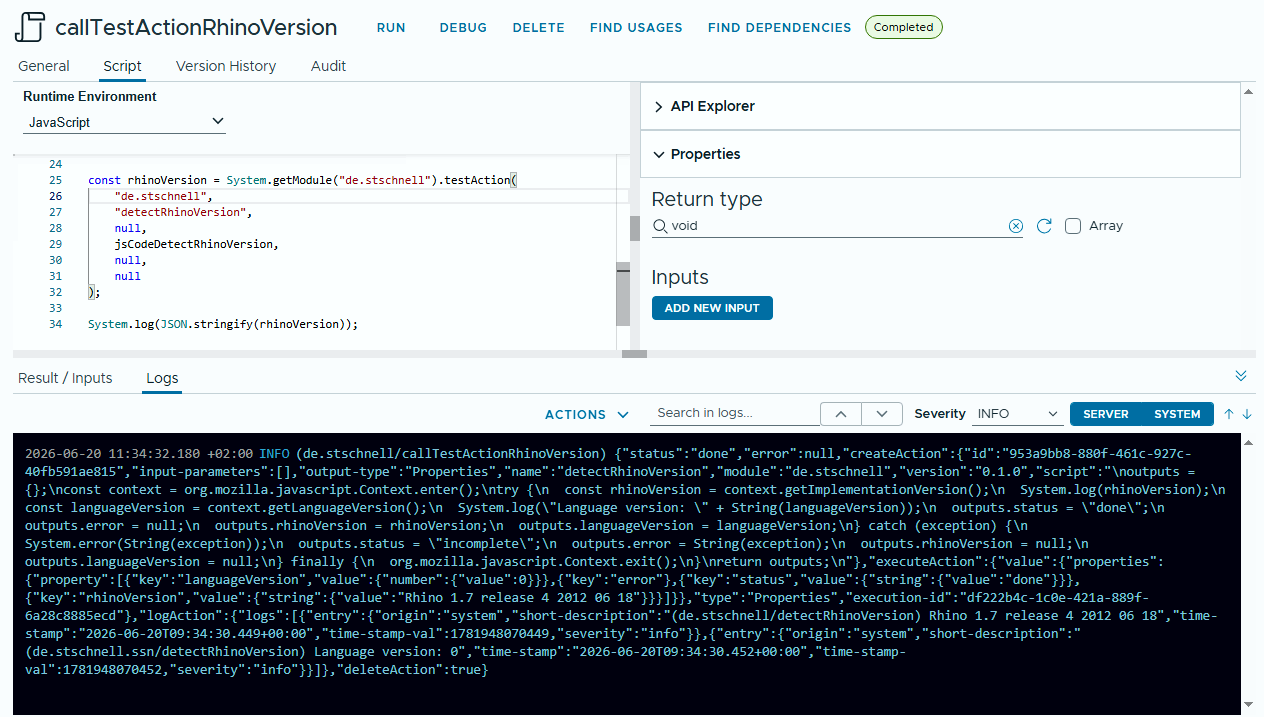
System.getModule("de.stschnell").testAction(
  "de.stschnell",
  "helloWorld",
  "string",
  "System.log(\"Hello World\");\n" +
  "return \"Hello World\"",
  null,
  null
);

@example
System.getModule("de.stschnell").testAction(
  "de.stschnell",
  "helloWorld",
  null,
  "import json\n" +
  "def handler(context, inputs):\n" +
  "  print(\"Hello World\")\n" +
  "  return {\"result\": \"Hello World\"}",
  null,
  "python:3.10"
);

Checked with Aria Automation 8.18.1
"""


import ast
import json
import ssl
import time
import urllib.error
import urllib.request


def createAction(
  vcoUrl: str,
  bearerToken: str,
  actionModule: str,
  actionName: str,
  outputType: str | None,
  script: str,
  version: str | None,
  runtime: str | None
) -> dict:
    """ Creates an action in the Orchestrator
    """

    try:

        if (
            not vcoUrl
            or not vcoUrl.strip()
            or not bearerToken
            or not bearerToken.strip()
        ):
            raise ValueError("vcoUrl or bearerToken argument "
                             "cannot be undefined or null")

        if (
            not actionModule
            or not actionModule.strip()
            or not actionName
            or not actionName.strip()
        ):
            raise ValueError("actionModule or actionName argument "
                             "cannot be undefined or null")

        _outputType: str = outputType \
        if (outputType and outputType.strip()) else "Properties"

        if not script or not script.strip():
            raise ValueError("script argument "
                             "cannot be undefined or null")

        _version: str = version \
        if (version and version.strip()) else "0.1.0"

        url = f"{vcoUrl.rstrip('/')}/api/actions"

        body: dict = {
            "input-parameters": [],
            "module": actionModule,
            "name": actionName,
            "output-type": _outputType,
            "script": script,
            "version": _version
        }

        if runtime and runtime.strip():
            body["runtime"] = runtime

        request = urllib.request.Request(
            url = url,
            method = "POST",
            data = json.dumps(body).encode("utf-8")
        )

        request.add_header("Content-Type", "application/json")
        request.add_header("Accept", "application/json, text/plain, */*")
        request.add_header("Authorization", f"Bearer {bearerToken}")

        response = urllib.request.urlopen(
            request,
            context = ssl._create_unverified_context()
        )

        responseCode: int = response.status

        if responseCode == 201:
            try:
                return json.loads(response.read().decode("utf-8"))
            except json.JSONDecodeError as jsonErr:
                raise RuntimeError(f"Invalid JSON response: {jsonErr}")
        else:
            raise RuntimeError(f"Unexpected HTTP status code: {responseCode}")

    except urllib.error.HTTPError as err:
        errorDetails = err.read().decode("utf-8")
        raise RuntimeError(f"HTTP error {err.code} at createAction: "
                           f"{errorDetails}") from err
    except Exception as err:
        raise RuntimeError(f"Error at createAction: {err}") from err


def executeAction(
  vcoUrl: str,
  bearerToken: str,
  actionId: str
) -> dict:
    """ Invokes an action in the Orchestrator
    """

    try:

        if (
            not vcoUrl
            or not vcoUrl.strip()
            or not bearerToken
            or not bearerToken.strip()
        ):
            raise ValueError("vcoUrl or bearerToken argument "
                             "cannot be undefined or null")

        if not actionId or not actionId.strip():
            raise ValueError("actionId argument "
                             "cannot be undefined or null")

        url = f"{vcoUrl.rstrip('/')}/api/actions/{actionId}/executions"

        body: dict = {
            "async-execution": False,
            "parameters": []
        }
        data = bytes(json.dumps(body).encode("utf-8"))

        request = urllib.request.Request(
            url = url,
            method = "POST",
            data = data
        )

        request.add_header("Content-Type", "application/json")
        request.add_header("Accept", "application/json, text/plain, */*")
        request.add_header("Authorization", f"Bearer {bearerToken}")

        response = urllib.request.urlopen(
            request,
            context = ssl._create_unverified_context()
        )

        responseCode: int = response.status

        if responseCode == 200:
            try:
                return json.loads(response.read().decode("utf-8"))
            except json.JSONDecodeError as jsonErr:
                raise RuntimeError(f"Invalid JSON response: {jsonErr}")
        else:
            raise RuntimeError(f"Unexpected HTTP status code: {responseCode}")

    except urllib.error.HTTPError as err:
        errorDetails = err.read().decode("utf-8")
        raise RuntimeError(f"HTTP Error {err.code} at executeAction: "
                           f"{errorDetails}") from err
    except Exception as err:
        raise RuntimeError(f"Error at executeAction: {err}") from err


def getActionLog(
  vcoUrl: str,
  bearerToken: str,
  executionId: str
) -> dict:
    """ Delivers the content of the action log
    """

    try:

        if (
            not vcoUrl
            or not vcoUrl.strip()
            or not bearerToken
            or not bearerToken.strip()
        ):
            raise ValueError("vcoUrl or bearerToken argument "
                             "cannot be undefined or null")

        if not executionId or not executionId.strip():
            raise ValueError("executionId argument "
                             "cannot be undefined or null")

        url = (f"{vcoUrl.rstrip('/')}/api/actions/{executionId}"
                "/logs?maxResult=2147483647")

        request = urllib.request.Request(
            url = url,
            method = "GET"
        )

        request.add_header("Accept", "application/json, text/plain, */*")
        request.add_header("Authorization", f"Bearer {bearerToken}")

        response = urllib.request.urlopen(
            request,
            context = ssl._create_unverified_context()
        )

        responseCode: int = response.status

        if responseCode == 200:
            rawData = response.read().decode("utf-8")
            try:
                return json.loads(rawData)
            except json.JSONDecodeError as jsonErr:
                try:
                    return ast.literal_eval(rawData)
                except (ValueError, SyntaxError) as astErr:
                    return {"logRawData": rawData}
        else:
            return {}

    except urllib.error.HTTPError as err:
        errorDetails = err.read().decode("utf-8")
        raise RuntimeError(f"HTTP Error {err.code} at getActionLog: "
                           f"{errorDetails}") from err
    except Exception as err:
        print(f"Error at getActionLog: {err}")
        return {}


def deleteAction(
  vcoUrl: str,
  bearerToken: str,
  actionId: str
) -> bool:
    """ Removes an action in the Orchestrator
    """

    try:

        if (
            not vcoUrl
            or not vcoUrl.strip()
            or not bearerToken
            or not bearerToken.strip()
        ):
            raise ValueError("vcoUrl or bearerToken argument "
                             "cannot be undefined or null")

        if not actionId or not actionId.strip():
            raise ValueError("actionId argument "
                             "cannot be undefined or null")

        url = f"{vcoUrl.rstrip('/')}/api/actions/{actionId}?force=false"

        request = urllib.request.Request(
            url = url,
            method = "DELETE"
        )

        request.add_header("Accept", "application/json, text/plain, */*")
        request.add_header("Authorization", f"Bearer {bearerToken}")

        response = urllib.request.urlopen(
            request,
            context = ssl._create_unverified_context()
        )

        responseCode: int = response.status

        if responseCode == 200:
            return True
        else:
            return False

    except Exception as err:
        print(f"Error at deleteAction: {err}")
        return False


def handler(
    context: dict,
    inputs: dict
) -> dict:

    outputs: dict = {}
    actionId: str | None = None
    executionId: str | None = None

    try:

        vcoUrl: str = context["vcoUrl"]
        bearerToken: str = context["getToken"]()
        actionModule: str = inputs["in_actionModule"]
        actionName: str = inputs["in_actionName"]
        outputType: str | None = inputs["in_outputType"]
        script: str = inputs["in_script"]
        version: str | None = inputs["in_version"]
        runtime: str | None = inputs["in_runtime"]

        action: dict = createAction(
            vcoUrl,
            bearerToken,
            actionModule,
            actionName,
            outputType,
            script,
            version,
            runtime
        )

        actionId = action["id"] if isinstance(action, dict) else None
        if not actionId:
            raise RuntimeError("Action creation returned no valid ID")

        result: dict = executeAction(
            vcoUrl,
            bearerToken,
            actionId
        )

        executionId = result["execution-id"] \
        if isinstance(result, dict) else None
        if not executionId:
            raise RuntimeError("Action execution returned no valid ID")

        log: dict = {}
        maxAttempts = 10 # Increase for long-running or complex tests
        checkInterval = 1
        attemptCounter = 0

        while attemptCounter < maxAttempts:

            log = getActionLog(
                vcoUrl,
                bearerToken,
                executionId
            )

            if log and len(log["logs"]) > 0:
                break

            time.sleep(checkInterval)
            attemptCounter += 1

        if attemptCounter >= maxAttempts:
            print("Warning: Logging timeout, "
                  "logs might be incomplete or missing")

        outputs["status"] = "done"
        outputs["error"] = None
        outputs["createAction"] = action
        outputs["executeAction"] = result
        outputs["logAction"] = log

    except Exception as err:

        outputs["status"] = "incomplete"
        outputs["error"] = str(err)
        outputs["createAction"] = None
        outputs["executeAction"] = None
        outputs["logAction"] = None

    finally:

        if actionId:
            deleted: bool = deleteAction(
              vcoUrl,
              bearerToken,
              actionId
            )
            outputs["deleteAction"] = deleted
        else:
            outputs["deleteAction"] = None

    return outputs


if __name__ == "__main__":
    # Call the sequence from here, if you are not in the Orchestrator
    # createAction()
    # executeAction()
    # getActionLog()
    # deleteAction()
    pass
|