"""
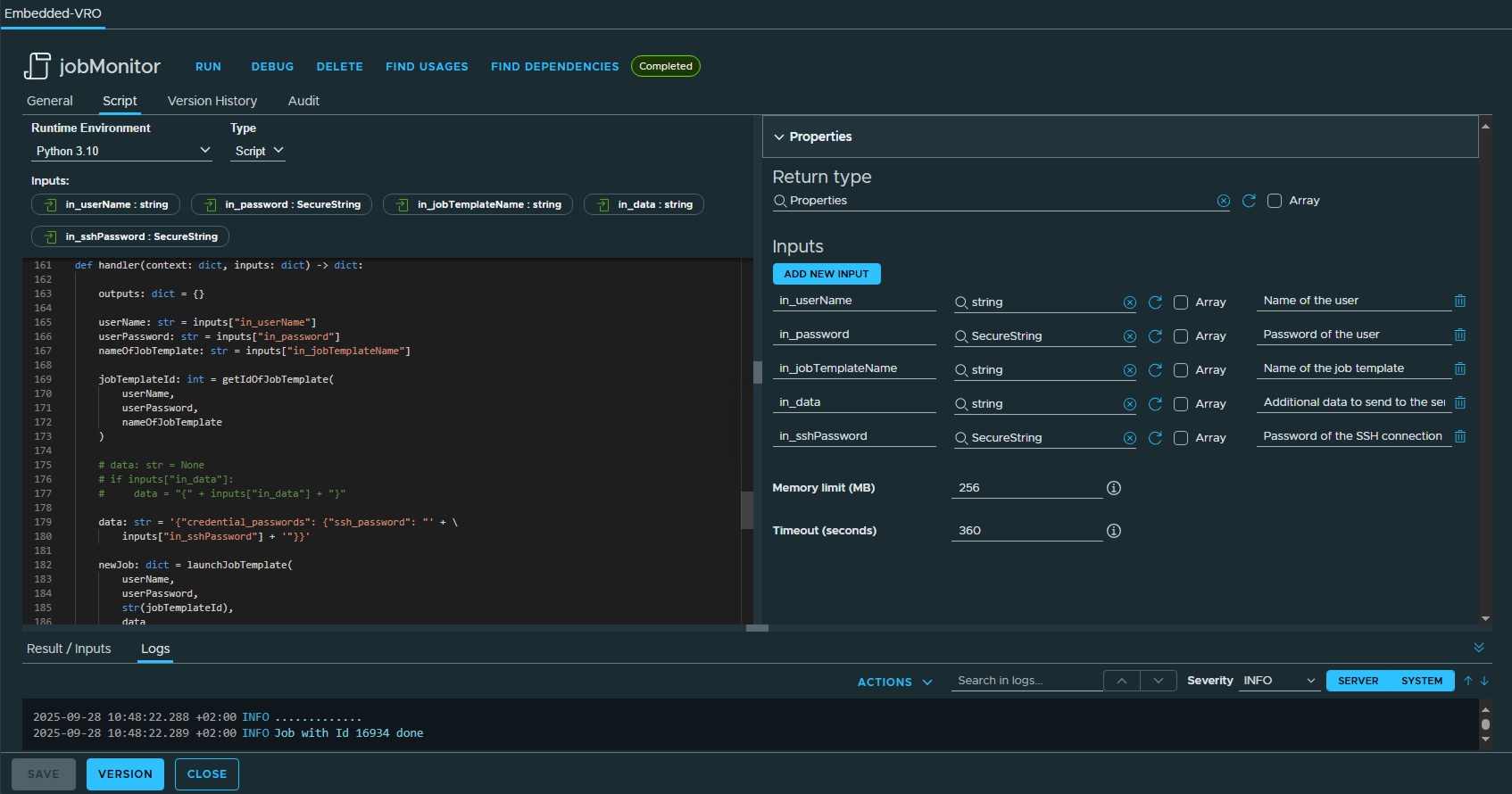
Ansible job monitor

@author Stefan Schnell <mail@stefan-schnell.de>
@version 0.5.1

@param {string} in_userName - Name of the Ansible user
@param {SecureString} in_password - Password of the Ansible user
@param {string} in_jobTemplateName - Name of the AAP job template
@param {string} in_data - Additional data to send to the server
@param {SecureString} in_sshPassword - Password of the SSH connection
@param {string} in_inventoryName - Name of the AAP inventory
@param {string} in_credentialName - Name of the AAP credential
@outputType Properties

Important hint:
The "Prompt on Launch" field, next to the "Inventory" and/or
"Credential" field in the Ansible Automation Platform, must be enabled,
when using the parameters in_inventoryName and/or in_credentialName.

@example
in_userName = myAAPName
in_password = secret
in_jobTemplateName = myAAPTestTemplate
in_data = {"extra_vars": {"name": "Stefan", "password": "secret"}}
in_sshPassword = secret
in_inventoryName = myAAPInventoryName
in_credentialName = myAAPCredentialName
"""

import ast
import base64
import http.client
import json
import math
import re
import ssl
import time
import urllib.error
import urllib.request


def ansibleApiCall(
    userName: str,
    userPassword: str,
    apiCall: str,
    method: str = "GET",
    data: str | None = None
) -> dict | bytes | None:
    """ Sends a request to the Ansible endpoint
    """

    url: str = "https://yourAnsibleAutomationPlatformURL"
    url += apiCall

    response: http.client.HTTPResponse | None = None
    result: dict | bytes | None = None

    try:

        request = urllib.request.Request(
            url = url,
            method = method,
            data = data
        )

        print(f"Ansible {method} request: {url}")
        if data:
            print(f"with {data}")

        authorization: str = base64.b64encode(
            bytes(userName + ":" + userPassword, "UTF-8")
        ).decode("UTF-8")
        authorization = "Basic " + authorization

        request.add_header("Authorization", authorization)
        request.add_header("Content-Type", "application/json")

        response = urllib.request.urlopen(
            request,
            context = ssl.create_default_context()
            #context = ssl._create_unverified_context()
        )

        responseCode: int = response.status
        responseRead: bytes = response.read()

        if responseCode in (200, 201, 202, 204):
            if len(responseRead) > 0:
                result = json.loads(responseRead)
            else:
                result = response
        else:
            raise urllib.error.HTTPError(
                url,
                responseCode,
                f"API call failed with status code {responseCode}",
                response.headers,
                None
            )

    except Exception as err:
        raise RuntimeError(
            f"An error occurred at ansibleApiCall: {err}"
        ) from err

    finally:
        if response is not None:
            response.close()

    return result


def jsonStringToDict(
    jsonString: str
) -> dict:
    """ Converts JSON string to dictionary via Abstract Syntax Tree (AST)
    """

    jsonDict: dict = {}

    try:
        jsonDict = json.loads(jsonString)
    except:
        try:
            jsonDict = ast.literal_eval(jsonString)
        except Exception as err:
            raise Exception("An error occurred at " + \
                "JSON string to dictionary") from err

    return jsonDict


def getIdOfInventory(
    userName: str,
    userPassword: str,
    inventoryName: str
) -> int:
    """ Detects the ID of an Ansible inventory
    """

    try:

        cntInventories: int = int(jsonStringToDict(str(
            ansibleApiCall(
                userName,
                userPassword,
                "/api/controller/v2/inventories/?page_size=1"
            )
        ))["count"])

        inventories: dict = {"count": cntInventories, "results": []}

        pageSize: int = 64
        totalPages = math.ceil(cntInventories / pageSize)

        for page in range(1, totalPages + 1):

            pageResponse = jsonStringToDict(str(
                ansibleApiCall(
                    userName,
                    userPassword,
                    f"/api/controller/v2/inventories/"
                    f"?page_size={pageSize}&page={page}"
                )
            ))

            inventories["results"].extend(pageResponse.get("results", []))

        for inventory in inventories["results"]:
            if (inventory["name"] == inventoryName):
                return inventory["id"]

    except Exception as err:
        raise RuntimeError(
            f"An error occurred at getIdOfInventory: {err}"
        ) from err


def getIdOfCredential(
    userName: str,
    userPassword: str,
    credentialName: str
) -> int:
    """ Detects the ID of an Ansible credential
    """

    try:

        cntCredentials: int = int(jsonStringToDict(str(
            ansibleApiCall(
                userName,
                userPassword,
                "/api/controller/v2/credentials/?page_size=1"
            )
        ))["count"])

        credentials: dict = {"count": cntCredentials, "results": []}

        pageSize: int = 64
        totalPages = math.ceil(cntCredentials / pageSize)

        for page in range(1, totalPages + 1):

            pageResponse = jsonStringToDict(str(
                ansibleApiCall(
                    userName,
                    userPassword,
                    f"/api/controller/v2/credentials/"
                    f"?page_size={pageSize}&page={page}"
                )
            ))

            credentials["results"].extend(pageResponse.get("results", []))

        for credential in credentials["results"]:
            if (credential["name"] == credentialName):
                return credential["id"]

    except Exception as err:
        raise RuntimeError(
            f"An error occurred at getIdOfCredential: {err}"
        ) from err


def getIdOfJobTemplate(
    userName: str,
    userPassword: str,
    jobTemplateName: str
) -> tuple[ int, bool, bool ]:
    """ Detects the ID of an Ansible job template
    """

    try:

        cntTemplates: int = int(jsonStringToDict(str(
            ansibleApiCall(
                userName,
                userPassword,
                "/api/controller/v2/job_templates/?page_size=1"
            )
        ))["count"])

        templates: dict = {"count": cntTemplates, "results": []}

        pageSize: int = 32
        totalPages = math.ceil(cntTemplates / pageSize)

        for page in range(1, totalPages + 1):

            pageResponse = jsonStringToDict(str(
                ansibleApiCall(
                    userName,
                    userPassword,
                    f"/api/controller/v2/job_templates/"
                    f"?page_size={pageSize}&page={page}"
                )
            ))

            templates["results"].extend(pageResponse.get("results", []))

        for template in templates["results"]:
            if (template["name"] == jobTemplateName):
                return (
                    template["id"],
                    template["ask_inventory_on_launch"],
                    template["ask_credential_on_launch"]
                )

    except Exception as err:
        raise RuntimeError(
            f"An error occurred at getIdOfJobTemplate: {err}"
        ) from err

    return None, None, None


def launchJobTemplate(
    userName: str,
    userPassword: str,
    templateId: str,
    data: str | None = None
) -> dict:
    """ Invokes an Ansible job template
    """

    try:

        result: str = str(
            ansibleApiCall(
                userName,
                userPassword,
                f"/api/controller/v2/job_templates/{templateId}/launch/",
                "POST",
                data.encode() if data else None
            )
        )

        return jsonStringToDict(result)

    except Exception as err:
        raise RuntimeError(
            f"An error occurred at launchJobTemplate: {err}"
        ) from err


def getJobOutput(
    userName: str,
    userPassword: str,
    jobId: str
) -> dict:
    """ Gets the output of an executed Ansible job
    """

    try:

        result: str = str(
            ansibleApiCall(
                userName,
                userPassword,
                f"/api/controller/v2/jobs/{jobId}/stdout/?format=json"
            )
        )

        return jsonStringToDict(result)

    except Exception as err:
        raise RuntimeError(
            f"An error occurred at getJobOutput: {err}"
        ) from err


def getJobEvents(
    userName: str,
    userPassword: str,
    jobId: str
) -> dict:
    """ Gets the events of an executed Ansible job
    """

    try:

        result: str = str(
            ansibleApiCall(
                userName,
                userPassword,
                f"/api/controller/v2/jobs/{jobId}/job_events"
            )
        )

        return jsonStringToDict(result)

    except Exception as err:
        raise RuntimeError(
            f"An error occurred at getJobEvents: {err}"
        ) from err


def handler(context: dict, inputs: dict) -> dict:

    outputs: dict = {}
    jobOutput: dict = {"content": ""}
    jobEvents: dict = {}

    userName: str = inputs["in_userName"]
    userPassword: str = inputs["in_password"]
    nameOfJobTemplate: str = inputs["in_jobTemplateName"]

    try:

        jobTemplateId: int
        askInventory: bool
        askCredential: bool

        jobTemplateId, askInventory, askCredential = getIdOfJobTemplate(
            userName,
            userPassword,
            nameOfJobTemplate
        )

        if not jobTemplateId:
            raise ValueError("Error at job template Id")

        payload: dict = {}


        if inputs.get("in_data"):
            additionalPayload: dict = json.loads(inputs["in_data"])
            payload.update(additionalPayload)

        if inputs.get("in_inventoryName") and askInventory:

            inventoryId: int = getIdOfInventory(
                userName,
                userPassword,
                inputs["in_inventoryName"]
            )

            if not inventoryId:
                raise ValueError("Error at inventory id")

            payload["inventory"] = inventoryId

        if inputs.get("in_credentialName") and askCredential:

            credentialId: int = getIdOfCredential(
                userName,
                userPassword,
                inputs["in_credentialName"]
            )

            if not credentialId:
                raise ValueError("Error at credential id")

            payload["credentials"] = [credentialId]

        else:

            if inputs["in_sshPassword"]:

                payload["credential_passwords"] = {
                    "ssh_password": inputs["in_sshPassword"]
                }

        data: str = json.dumps(payload)

        newJob: dict = launchJobTemplate(
            userName,
            userPassword,
            str(jobTemplateId),
            data
        )

        newJobId: int = newJob["id"]

        if not newJobId:
            raise ValueError("Error at new job Id")

        jobStatus: str | None = None
        jobSummary: dict | None = None

        while (
            jobStatus is None or
            jobStatus in ("running", "pending", "waiting")
        ):

            jobSummary = jsonStringToDict(str(ansibleApiCall(
                userName,
                userPassword,
                f"/api/controller/v2/jobs/{newJobId}"
            )))

            jobStatus: str = jobSummary["status"]

            time.sleep(0.125)

        print(f"Job with Id {newJobId} done, with the status {jobStatus}")

        jobOutput = getJobOutput(
            userName,
            userPassword,
            str(newJobId)
        )

        jobEvents = getJobEvents(
            userName,
            userPassword,
            str(newJobId)
        )["results"]

        changedValue: dict | None = None
        for jobEvent in jobEvents:
            if jobEvent.get("event") == "playbook_on_stats":
                changedValue = (
                    jobEvent.get("event_data", {}).get("changed", {})
                )
                break

        if changedValue is not None:
            print(f"Changed value: {sum(changedValue.values())}")
        else:
            print("Can not determine Changed value")

            totalChanges: int = 0
            for jobEvent in jobEvents:
                if (
                    jobEvent.get("event") == "runner_on_ok" and
                    jobEvent.get("changed") is True
                ):
                    total_changes += 1

            print(f"Changed value from fallback: {total_changes}")

        outputs = {
            "status": "done",
            "error": None,
            "newJobId": newJobId,
            "jobSummary": jobSummary,
            "jobEvents": jobEvents,
            "jobOutput": jobOutput["content"]
        }

    except Exception as err:

        errorMessage: str = (
            str(err) if str(err)
            else err.__class__.__name__
        )

        print(f"ERROR: {errorMessage}")

        outputs = {
            "status": "incomplete",
            "error": errorMessage,
            "newJobId": None,
            "jobSummary": None,
            "jobEvents": None,
            "jobOutput": None
        }

    return outputs
|